3,4',5,7-tetrahydroxy-3'-methoxy-flavone, 3,4',5,7-tetrahydroxy-3'-methoxyflavone, 3-methyl-quercetin, 3-methylquercetin, 3-O-methylquercetin, iso-rhamnetin, isorhamnetin, isorhamnetine


| Name | Isorhamnetin | ||
| PubChem CID | 5281654 | ||
| Molecular Weight | 316.26g/mol | ||
| Synonyms |
3,4',5,7-tetrahydroxy-3'-methoxy-flavone, 3,4',5,7-tetrahydroxy-3'-methoxyflavone, 3-methyl-quercetin, 3-methylquercetin, 3-O-methylquercetin, iso-rhamnetin, isorhamnetin, isorhamnetine |
||
| Formula | C₁₆H₁₂O₇ | ||
| SMILES | COC1=C(C=CC(=C1)C2=C(C(=O)C3=C(C=C(C=C3O2)O)O)O)O | ||
| InChI | 1S/C16H12O7/c1-22-11-4-7(2-3-9(11)18)16-15(21)14(20)13-10(19)5-8(17)6-12(13)23-16/h2-6,17-19,21H,1H3 | ||
| InChIKey | IZQSVPBOUDKVDZ-UHFFFAOYSA-N | ||
| CAS Number | 480-19-3 | ||
| ChEMBL ID | CHEMBL379064 | ||
| ChEBI ID | CHEBI:6052 | ||
| Herb ID | HBIN031114 | ||
| Drug Bank ID | DB16767 | ||
| KEGG ID | C10084 | ||
| Toxicity | Organism | Test Type | Route(Dose) |
| rat | LD50 | intraperitoneal(165 mg/kg) | |
| mouse | LD50 | intraperitoneal(254 mg/kg) | |
| rat | LD50 | oral(322 mg/kg) | |
| Structure | 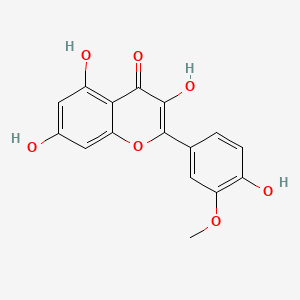
|
Download
2D
MOL
3D
MOL
|
|
| Chineses Pinyin | XuanFuHua | ||
| Use Part | Flower-Head | ||
| Habitat | HeiLongJiang, JiLin, LiaoNing, BeiJing, TianJin, HeBei, ShanXi, NeiMengGu, Shaanxi, GanSu, QingHai, NingXia, XinJiang, ZheJiang, JiangSu, SiChuan, GuangDong | ||
| Flavor | Bitter, Salty, Pungent | ||
| Meridian Tropism | Lung, Spleen, Stomach, Large intestine | ||
| Species |
>Kingdom: Viridiplantae
-->Phylum: Streptophyta
-->Class: Equisetopsida
-->Order: Asterales
-->Family: Asteraceae
-->Genus: Inula
-->Species: Inula japonica
|
||
| Chineses Pinyin | BaiGuoYe | ||
| Use Part | Leaf | ||
| Habitat | China | ||
| Flavor | Bitter, Sweet, Astringent | ||
| Meridian Tropism | Heart, Lung, Spleen | ||
| Chineses Pinyin | ShaJi | ||
| Use Part | Fruit of seabuckthorn | ||
| Habitat | BeiJing, TianJin, HeBei, ShanXi, NeiMengGu, Shaanxi, GanSu, QingHai, NingXia, XinJiang, SiChuan, XiZang | ||
| Flavor | Sour; Astringent | ||
| Meridian Tropism | Spleen; Stomach; Lung; Heart | ||
| Species |
>Kingdom: Viridiplantae
-->Phylum: Streptophyta
-->Class: Equisetopsida
-->Order: Rosales
-->Family: Elaeagnaceae
-->Genus: Hippophae
-->Species: Hippophae rhamnoides
|
||
| Pair Name | Isorhamnetin, Chloroquine | |||
| Partner Name | Chloroquine | |||
| Disease Info | [ICD-11: 2C60] | Breast cancer | Investigative | |
| Biological Phenomena | Induction-->Mitochondrial fission and apoptosis | |||
| Gene Regulation | Up-regulation | Phosphorylation | CAMK2G | hsa818 |
| Up-regulation | Phosphorylation | DNM1L | hsa10059 | |
| Up-regulation | Cleavage | PARP1 | hsa142 | |
| Up-regulation | Cleavage | CASP3 | hsa836 | |
| Up-regulation | Expression | CYCS | hsa54205 | |
| Up-regulation | Expression | MAP1LC3B | hsa81631 | |
| Up-regulation | Expression | MAP1LC3A | hsa84557 | |
| Down-regulation | Expression | SQSTM1 | hsa8878 | |
| In Vitro Model | MDA-MB-231 | Breast adenocarcinoma | Homo sapiens (Human) | CVCL_0062 |
| MCF-7 | Invasive breast carcinoma of no special type | Homo sapiens (Human) | CVCL_0031 | |
| BT-549 | Invasive breast carcinoma of no special type | Homo sapiens (Human) | CVCL_1092 | |
| In Vivo Model | MDA-MB-231 cells (4×10⁷) were inoculated in the right legs of mice. After tumor inoculation, the mice were randomly divided into four treatment groups (16 mice per group; six mice were used for body weight and tumor volume measurement, the others for survival analysis). | |||
| Result | Our study highlights the critical role of ROS-mediating CaMKII/Drp1 signaling in the regulation of mitochondrial fission and apoptosis induced by combination of CQ/IH. These findings also suggest that IH could potentially be further developed as a novel chemotherapeutic agent. Furthermore, a combination of IH with classic autophagy/mitophagy inhibitor could represent a novel therapeutic strategy for the treatment of TNBC. | |||
| Pair Name | Isorhamnetin, Doxorubicin | |||
| Partner Name | Doxorubicin | |||
| Disease Info | [ICD-11: 2C60] | Breast cancer | Investigative | |
| Biological Phenomena | Induction-->Blockade of cell cycle in G2/M phase | |||
| Gene Regulation | Down-regulation | Expression | PRKAA1 | hsa5562 |
| Down-regulation | Expression | MTOR | hsa2475 | |
| Down-regulation | Expression | RPS6KB1 | hsa6198 | |
| Down-regulation | Expression | BCL2 | hsa596 | |
| Up-regulation | Cleavage | CASP3 | hsa836 | |
| In Vitro Model | NCI-ADR-RES | High grade ovarian serous adenocarcinoma | Homo sapiens (Human) | CVCL_1452 |
| In Vivo Model | a total of 0.1 ml of medium and Matrigel suspension containing 8×10⁷ MCF7/ADR cells was prepared for subcutaneous inoculation. | |||
| Result | Isorhamnetin induces cell cycle arrest and apoptosis by triggering DNA damage and regulating the AMPK/mTOR/p70S6K signaling pathway in doxorubicin-resistant breast cancer | |||
| No. | Title | Href |
|---|---|---|
| 1 | ROS-mediated activation and mitochondrial translocation of CaMKII contributes to Drp1-dependent mitochondrial fission and apoptosis in triple-negative breast cancer cells by isorhamnetin and chloroquine. J Exp Clin Cancer Res. 2019 May 28;38(1):225. doi: 10.1186/s13046-019-1201-4. | Click |
| 2 | Isorhamnetin induces cell cycle arrest and apoptosis by triggering DNA damage and regulating the AMPK/mTOR/p70S6K signaling pathway in doxorubicin-resistant breast cancer. Phytomedicine. 2023 Jun;114:154780. doi: 10.1016/j.phymed.2023.154780. | Click |
