paeoniflorin, peoniflorin, peoniflorin sulfonate

| Name | Paeoniflorin | ||
| PubChem CID | 442534 | ||
| Molecular Weight | 480.5g/mol | ||
| Synonyms |
paeoniflorin, peoniflorin, peoniflorin sulfonate |
||
| Formula | C₂₃H₂₈O₁₁ | ||
| SMILES | CC12CC3(C4CC1(C4(C(O2)O3)COC(=O)C5=CC=CC=C5)OC6C(C(C(C(O6)CO)O)O)O)O | ||
| InChI | 1S/C23H28O11/c1-20-9-22(29)13-7-23(20,32-18-16(27)15(26)14(25)12(8-24)31-18)21(13,19(33-20)34-22)10-30-17(28)11-5-3-2-4-6-11/h2-6,12-16,18-19,24-27,29H,7-10H2,1H3/t12-,13-,14-,15+,16-,18+,19-,20+,21+,22-,23+/m1/s1 | ||
| InChIKey | YKRGDOXKVOZESV-WRJNSLSBSA-N | ||
| CAS Number | 23180-57-6 | ||
| ChEMBL ID | CHEMBL4303209 | ||
| ChEBI ID | CHEBI:7889 | ||
| Herb ID | HBIN038606 | ||
| Drug Bank ID | DB16288 | ||
| KEGG ID | C09959 | ||
| Toxicity | Organism | Test Type | Route(Dose) |
| rat | LD50 | intraperitoneal(165 mg/kg) | |
| mouse | LD50 | intraperitoneal(254 mg/kg) | |
| rat | LD50 | oral(322 mg/kg) | |
| Structure | 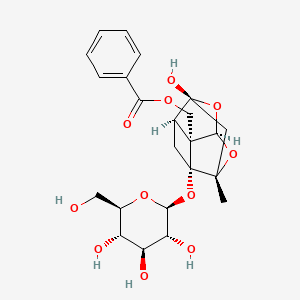
|
Download
2D
MOL
3D
MOL
|
|
| Chineses Pinyin | ZhiKe | ||
| Use Part | Fruit | ||
| Habitat | FuJian, Shaanxi, SiChuan, JiangXi, ZheJiang | ||
| Flavor | Bitter, Pungent, Sour | ||
| Meridian Tropism | Spleen, Stomach | ||
| Chineses Pinyin | ShaoYao | ||
| Use Part | Root | ||
| Habitat | ZheJiang, AnHui, SiChuan | ||
| Species |
>Kingdom: Viridiplantae
-->Phylum: Streptophyta
-->Class: Equisetopsida
-->Order: Saxifragales
-->Family: Paeoniaceae
-->Genus: Paeonia
-->Species: Paeonia lactiflora
|
||
| Pair Name | Paeoniflorin, Talatizidine | |||
| Partner Name | Talatizidine | |||
| Disease Info | [ICD-11: FA20] | Rheumatoid arthritis | Investigative | |
| Biological Phenomena | Induction-->Adipogenesis and lipogenesis | |||
| Gene Regulation | Up-regulation | Expression | PPARG | hsa5468 |
| Up-regulation | Expression | ALOX15B | hsa247 | |
| Down-regulation | Expression | JUN | hsa3725 | |
| Up-regulation | Expression | MMP13 | hsa4322 | |
| Down-regulation | Expression | TGFB1 | hsa7040 | |
| In Vivo Model | Male Lewis rats were injected intradermally at the base of the tail with 10 mg/mL M tuberculosis H37 Ra suspended in liquid paraffin. | |||
| Result | This study identified PAE and TLT as the main BACs of WTD in alleviating the severity of RA, and also developed a novel combination of PAE and TLT as a promising candidate drug for RA therapy. | |||
