4-(2,6,6-trimethyl-1-cyclohexen-1-yl)-3-buten-2-one, beta-ionone, beta-ionone, (trans)-isomer

| Name | Beta-Ionone | ||
| PubChem CID | 638014 | ||
| Molecular Weight | 192.30g/mol | ||
| Synonyms |
4-(2,6,6-trimethyl-1-cyclohexen-1-yl)-3-buten-2-one, beta-ionone, beta-ionone, (trans)-isomer |
||
| Formula | C₁₃H₂₀O | ||
| SMILES | CC1=C(C(CCC1)(C)C)C=CC(=O)C | ||
| InChI | 1S/C13H20O/c1-10-6-5-9-13(3,4)12(10)8-7-11(2)14/h7-8H,5-6,9H2,1-4H3/b8-7+ | ||
| InChIKey | PSQYTAPXSHCGMF-BQYQJAHWSA-N | ||
| CAS Number | 79-77-6 | ||
| ChEMBL ID | CHEMBL559945 | ||
| ChEBI ID | CHEBI:32325 | ||
| KEGG ID | C12287 | ||
| Toxicity | Organism | Test Type | Route(Dose) |
| rat | LD50 | intraperitoneal(165 mg/kg) | |
| mouse | LD50 | intraperitoneal(254 mg/kg) | |
| rat | LD50 | oral(322 mg/kg) | |
| Structure | 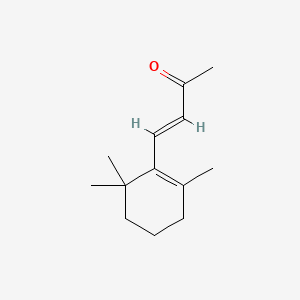
|
Download
2D
MOL
3D
MOL
|
|
| Chineses Pinyin | XiangJinCai | ||
| Use Part | Whole herb | ||
| Flavor | Pungent; Bitter | ||
| Species |
>Kingdom: Viridiplantae
-->Phylum: Streptophyta
-->Class: Equisetopsida
-->Order: Malpighiales
-->Family: Violaceae
-->Genus: Viola
-->Species: Viola odorata
|
||
| Pair Name | Beta-Ionone, Sorafenib | |||
| Partner Name | Sorafenib | |||
| Disease Info | [ICD-11: 2C12] | Hepatocellular carcinoma | Investigative | |
| Biological Phenomena | Inhibition-->Cell migration | |||
| Gene Regulation | Down-regulation | Expression | MMP9 | hsa4318 |
| Down-regulation | Expression | MMP2 | hsa4313 | |
| Up-regulation | Expression | TIMP1 | hsa7076 | |
| Up-regulation | Expression | TIMP2 | hsa7077 | |
| Down-regulation | Expression | PTK2 | hsa5747 | |
| Down-regulation | Expression | RAC1 | hsa5879 | |
| Down-regulation | Expression | RHO | hsa6010 | |
| In Vitro Model | SK-HEP-1 | Liver and intrahepatic bile duct epithelial neoplasm | Homo sapiens (Human) | CVCL_0525 |
| Result | SF enhanced the suppressing effect of BI (1-50 μM) on the viability of SK-Hep-1 cells, but not on murine hepatic BNL CL.2 cells, indicating the selective cytotoxicity of this combination on tumor cells. The combination of SF and BI could be a potential therapeutic strategy against human hepatoma cells. | |||
